01
Design files are plain-text, versioned JSON that live beside the code — diff, branch, review and merge them
A design canvas where humans and coding agents edit the same files.
A browser-native Figma alternative built for a world where designers and coding agents work on the same product — file-first, real-time and plugin-free.
Plain text
Design files in git
Any agent
Files · CLI · MCP
Browser-native
No install to view
MIT
Open source
The decisions, trade-offs, and details that make Weft worth your time.
Design files are plain-text, versioned JSON that live beside the code — diff, branch, review and merge them
Any agent, no plugin: files, a CLI, an MCP server and a live bridge share one documented contract
Browser-native editor with real-time presence, cursors, direct manipulation and undo/redo
Capture a running page into frames, then let an agent turn annotations into code changes
Pre-alpha with 256 tests and 7 browser E2E checks, MIT licensed
Weft closes the gap between the design file and the repository: the design is a directory of deterministic JSON and assets that lives beside the code, and every surface — editor, CLI, MCP server and live bridge — reads and writes the same document contract.
A design is a plain-text directory of deterministic JSON and assets. It diffs, reviews, branches and merges like everything else in the repository, and the file is the source of truth.
Agents get first-class access through files, a CLI, an MCP server and a live bridge. Hosted assistants, local harnesses and custom agents all use the same documented tools — no privileged built-in assistant.
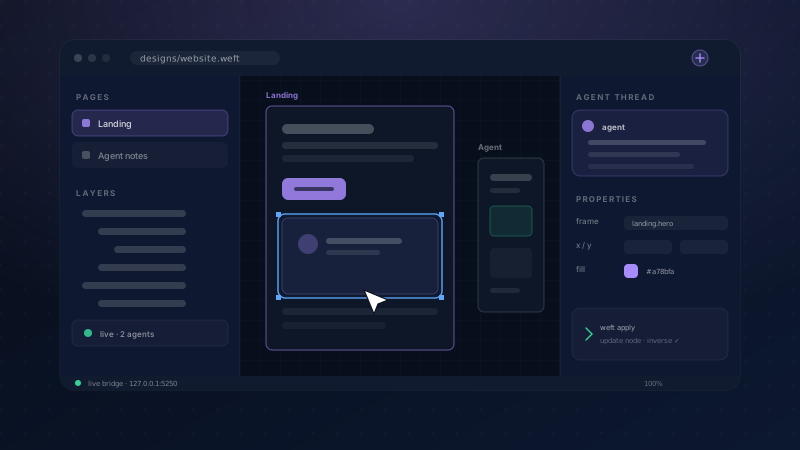
The editor renders the browser's own DOM, not a native runtime. Frames are labeled artboards, hover outlines show what a click will select, zoom anchors at the cursor, and Space-drag pans.
Presence, cursors and concurrent edits are part of the document layer. A Yjs-backed session applies attributed commands live and merges whole-page file writes without silently dropping live edits.
Capture a running allowlisted page — markup, styles and assets — into frames, annotate it, and let an agent turn those annotations into code changes. What you review is real DOM, not a screenshot.
Tokens, layout and content are structured data. The same file drives the canvas, a static HTML export, and an agent's implementation, with a published JSON Schema for non-TypeScript clients.
Every agent edit is a document operation with an author, a timestamp and an undo path. Commands return their inverse, so node, page and multi-selection changes can all be undone.
Plain text, browser APIs, a small dependency surface and no native runtime. The pre-alpha foundation is covered by 256 tests and 7 browser E2E checks.
One document contract connects the editor, the repository and any coding agent — so design and implementation stay in the same loop.
Run pnpm weft dev examples/starter.weft for the live editor, or pnpm dev for the static browser preview. The design directory is watched and the canvas updates as files change.
Select a layer, edit its properties, move and resize on the canvas, create frames and pages, and undo or redo through command inverses. Presence and cursors keep every collaborator in sync.
Point any MCP-capable agent at weft mcp, or let it read and write the files directly. Allowlisted reads, page/node commands, validation and context packets share one documented contract.
Capture a running frontend into a sanitized snapshot frame, then export static HTML, assets, tokens and an export manifest for handoff — or let an agent implement the next change.
Browser editor <--> Weft bridge <--> design files + git
                          |
                          +--> pi · opencode · Claude Code · Codex
                          |
                          +--> chat + tools

Running product --extract--> design filesA small, file-first stack built around browser APIs and a documented document model.
Licensed under MIT.
Weft is MIT-licensed and developed in public. Feedback, issues, and contributions are genuinely welcome.